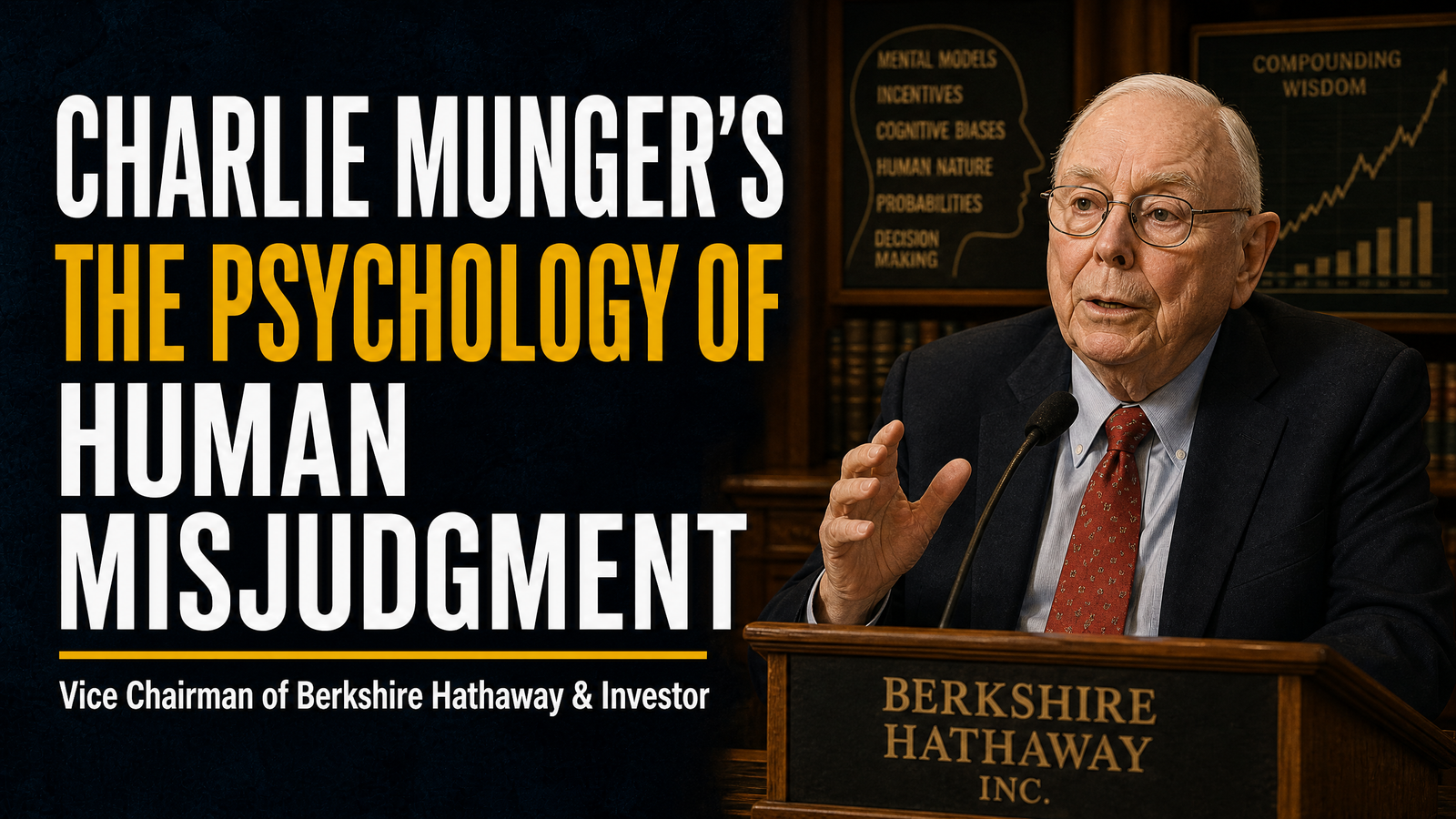
The Psychology of Human Misjudgment
Delivered as a landmark speech at Harvard University in 1995, Munger systematically mapped out 25 psychological tendencies and cognitive biases that lead human beings into flawed decisions and systemic errors.
Full Transcript
I have been interested in human misjudgment for a long time. When I was at Harvard Law School, we learned very little psychology. The psychology taught in departments was academic, isolated, and largely ignored behavioral economics and real-world cognitive tendencies.
If you want to avoid foolishness in life, you must understand the mental models that cause intelligent people to act foolishly.
First, consider the Incentive-Superpower Tendency. Never, ever, think about something else when you should be thinking about the power of incentives. Almost everyone thinks he fully understands incentives, but almost nobody realizes how dominant incentive drives truly are.
Second, consider Inconsistency-Avoidance Tendency. The brain of man conserves programming space by resisting change. You see this in confirmation bias, where people filter out evidence that contradicts their pre-existing beliefs.
To develop sound judgment, you must build a lattice-work of mental models drawn from all major disciplines—microeconomics, cognitive psychology, physics, and probability.
Defining Key Excerpts
"Show me the incentive and I'll show you the outcome."
"Acquire worldly wisdom and adjust your behavior accordingly. If your new behavior gives you a little temporary unpopularity... to hell with them."
Bring this Speech to your Wall
Get this historic speech professionally typeset, printed on structured canvas, and delivered in a solid wood frame.