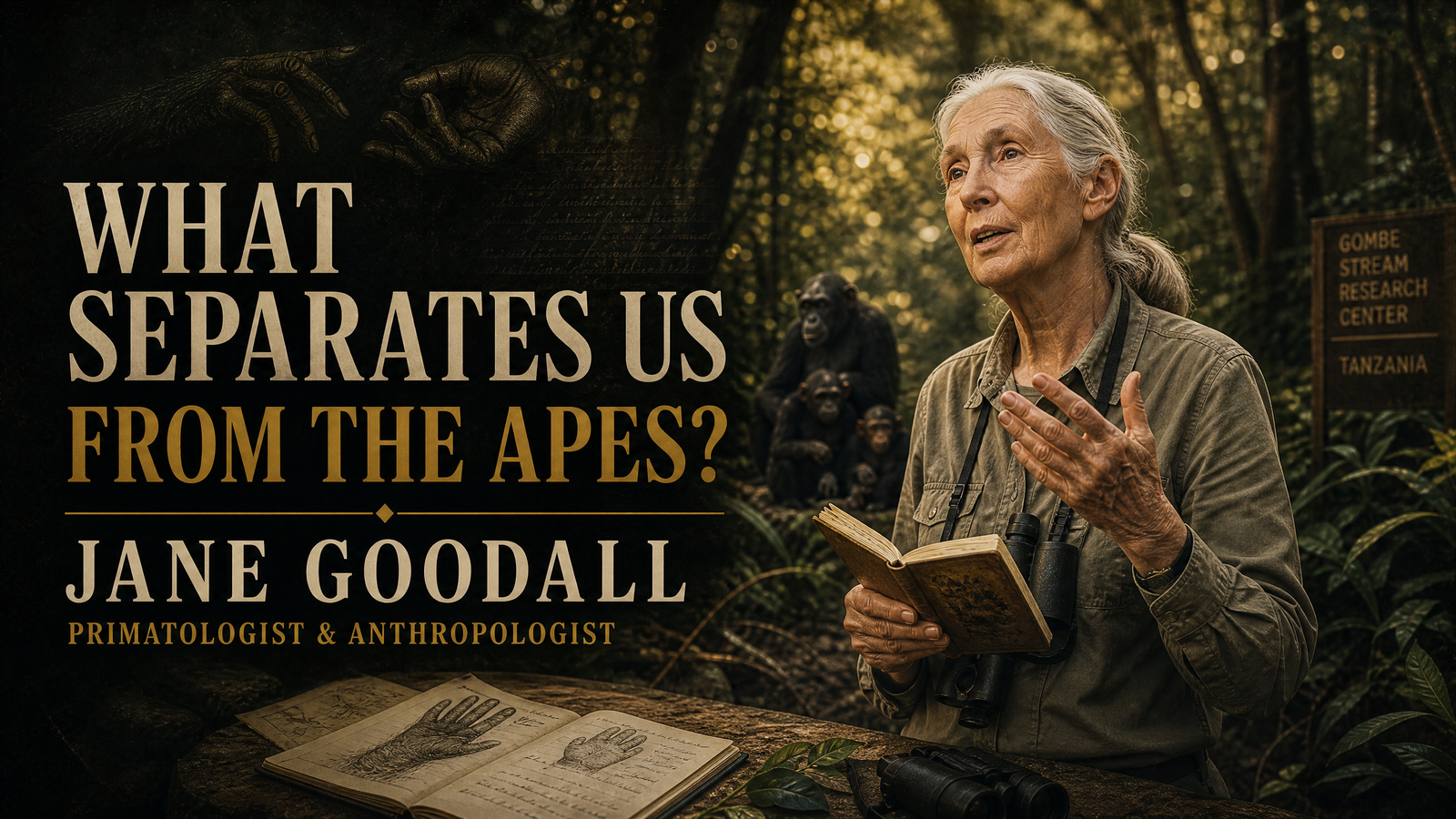
What Separates Us from the Apes?
Delivered at TED2002 in Monterey, California, reflecting on 40 years of studying chimpanzees at Gombe Stream and defining humanity's responsibility to nature.
Full Transcript
When I first arrived in Gombe in 1960, mainstream science believed that humans were the only creatures capable of making and using tools, possessing emotions, or showing personality.
When I observed David Greybeard—a wild male chimpanzee—strip leaves off a twig to fish for termites, I phoned Dr. Louis Leakey. He famously replied: ‘Now we must redefine tool, redefine Man, or accept chimpanzees as humans!’
Chimpanzees have taught us that there is no sharp line dividing humans from the rest of the animal kingdom. They share 98.6% of our DNA, show empathy, grieve for lost mothers, and engage in tool manufacture.
So what really separates us from the apes?
It is our extraordinary spoken and written language, which allows us to teach children about things that are not present, plan for the distant future, and share complex ideas.
And yet, the most intellectual creature that has ever walked the planet is destroying its only home. We must use our intellect and compassion to heal the damage we have inflicted upon the natural world.
Defining Key Excerpts
"The most intellectual creature that has ever walked the planet is destroying its only home."
"Chimpanzees have taught us that there is no sharp line dividing humans from the rest of the animal kingdom."
Bring this Speech to your Wall
Get this historic speech professionally typeset, printed on structured canvas, and delivered in a solid wood frame.