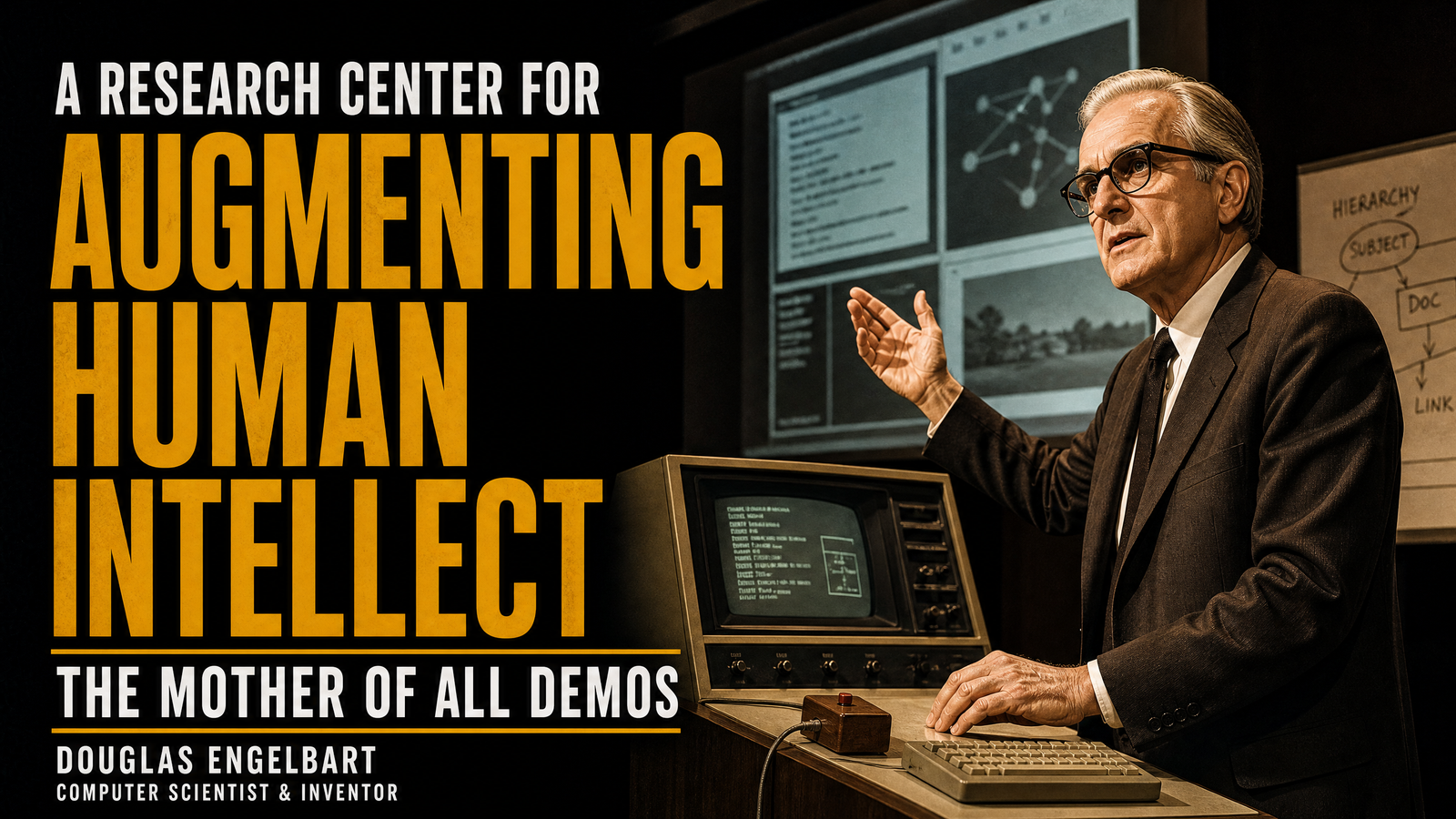
A Research Center for Augmenting Human Intellect ('The Mother of All Demos')
Delivered at the Fall Joint Computer Conference in San Francisco on December 9, 1968, Engelbart demonstrated the computer mouse, hypertext, real-time collaborative editing, video conferencing, and windowed UI in a legendary 90-minute presentation.
Full Transcript
If in your office you, as an intellectual worker, were supplied with a computer display backed up by a computer that was alive for you all day and responsive to your every command—how much value could you derive from that?
What I am going to show you today is the NLS (oN-Line System) developed at the Stanford Research Institute.
Notice this small wooden device on my desk with two rolling wheels and a button on top. We call it a ‘mouse.’ As I move it across the table, the cursor on the cathode-ray tube display moves simultaneously.
We can create structured documents, insert links between concepts—what we call hypertext—and instantly jump from one idea to another across thousands of connected files.
Furthermore, my colleague Bill Paxton, located thirty miles away in Menlo Park, is linked to this same screen via audio and video channels. We are editing the exact same document simultaneously in real time.
Our objective is not merely to speed up calculation, but to augment human intellect—to increase the capability of a person to handle complex problems, to gain comprehension tailored to his needs, and to derive solutions faster and more collaboratively.
Defining Key Excerpts
"If in your office you, as an intellectual worker, were supplied with a computer display backed up by a computer that was alive for you all day... how much value could you derive?"
"We aren't trying to build automated thinking machines; we are trying to augment human intellect to boost our collective capability to solve complex problems."
Bring this Speech to your Wall
Get this historic speech professionally typeset, printed on structured canvas, and delivered in a solid wood frame.