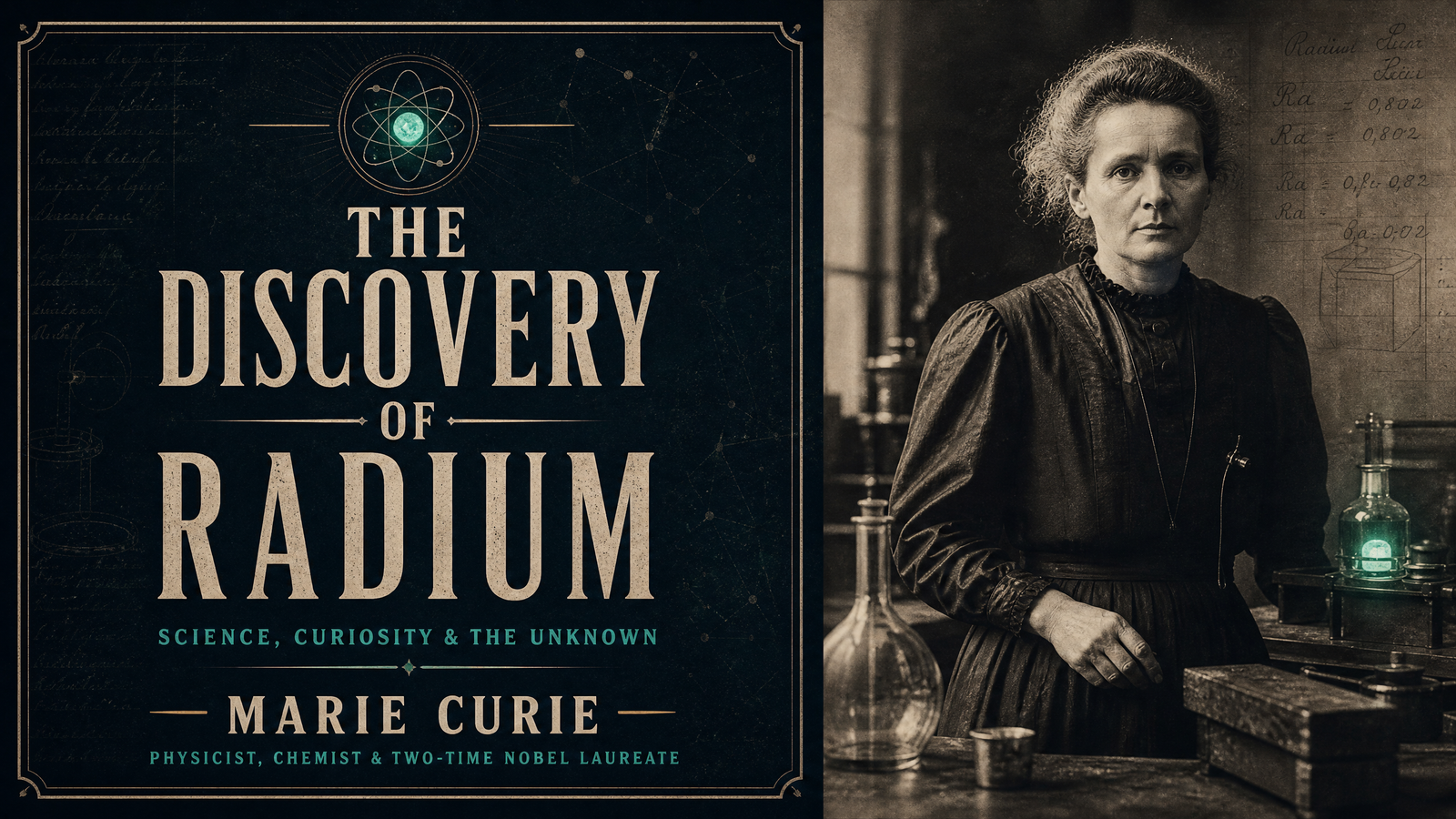
The Discovery of Radium
Delivered as her Nobel Lecture in Chemistry in Stockholm on December 11, 1911, Curie detailed her groundbreaking isolation of pure radium and polonium, establishing the fundamental science of radioactivity.
Full Transcript
Gentlemen: Some fifteen years ago, the radiation of uranium was discovered by Henri Becquerel, and two years later the study of this phenomenon was extended to other substances by me, and the word ‘radioactivity’ was introduced into science.
My experiments proved that the radiation of uranium compounds is an atomic property of the element uranium. I searched to see if there were other elements showing similar properties, and I found that thorium compounds act in the same way.
When Pierre Curie and I processed pitchblende ore, we discovered that its emissions were far stronger than could be accounted for by uranium alone. After arduous chemical separations, treating tons of mineral residue in a dilapidated shed, we isolated two new highly radioactive elements: polonium and radium.
Radium is no longer a laboratory curiosity. Its powerful emissions alter cellular structures, offering revolutionary promises in medicine for cancer treatment, and opening entirely new doors into atomic physics.
Science must remain free and unpatented. Radium belongs to no single individual; it belongs to humanity.
Defining Key Excerpts
"Nothing in life is to be feared, it is only to be understood. Now is the time to understand more, so that we may fear less."
"Radium is not to enrich any one. It is an element; it belongs to all the people."
Bring this Speech to your Wall
Get this historic speech professionally typeset, printed on structured canvas, and delivered in a solid wood frame.